Quick answer: White, chalky hard water stains are mostly calcium and magnesium carbonate left behind when water evaporates. A mild acid dissolves them. For glass, chrome, porcelain, and stainless steel, use plain white vinegar (about 5% acetic acid) or a citric acid solution of 1 to 2 tablespoons per cup of warm water, keep it in contact for 10 to 30 minutes, scrub with a non-scratch pad, then rinse and dry. Never use acids on marble, limestone, travertine, or other calcite-based stone, and never mix any acid with chlorine bleach. Orange, brown, or black stains are usually iron or manganese, not hardness, and need a different approach.
What hard water stains are made of
Hard water carries dissolved calcium and magnesium. When a film of water dries on a surface, or when it is heated, those minerals come out of solution as a crust that is mostly calcium carbonate. The US Geological Survey classifies water above 120 mg/L as calcium carbonate as hard and above 180 mg/L as very hard. The harder the water, the faster spots and scale build up. Our hard water calculator converts a utility or test-kit number into the same scale.
Calcium carbonate dissolves in acid, which is why vinegar and citric acid work. Baking soda is only a mild abrasive. Mixed with vinegar, the two neutralize each other, so use them separately. Soap scum, the gray film on shower walls, is soap that has reacted with calcium and magnesium. Acid helps, but a drop of dish soap first speeds things up.
How to remove hard water stains: the basic method
The same five steps work on most acid-safe surfaces. Only the strength and contact time change.
- Identify the surface using the table below. Acid that is harmless on glass can etch marble in minutes.
- Wash off soap and grime with warm water and a drop of dish soap so the acid reaches the mineral.
- Apply the acid and keep it wet. On vertical surfaces, press on a soaked paper towel and cover it with plastic wrap.
- Wait, then scrub gently. Allow 10 to 15 minutes for light spotting and 30 to 60 minutes, or a second round, for heavy crust. Use a soft brush or non-scratch pad.
- Rinse and dry. Remove all acid with clean water and dry with a microfiber cloth.
Strengths that work. White vinegar is sold at about 5% acidity. Cleaning vinegar, often 6% to 10%, works faster but is harsher on finishes. For citric acid, dissolve 1 to 2 tablespoons of powder (roughly 12 to 25 g) in a cup (250 mL) of warm water. It is nearly odorless, which helps in showers and appliances. Wear gloves and ventilate.
What is safe on each surface?
| Surface | Acid safe? | Best method | Avoid |
|---|---|---|---|
| Glass shower doors and windows | Yes | Vinegar or citric acid, 10 to 30 min, non-scratch pad | Steel wool, razor scraping on coated glass |
| Chrome-plated faucets and showerheads | Yes, short contact | Vinegar-soaked towel 10 to 30 min; showerhead soak up to 1 hour | Abrasive powders, overnight soaks on worn plating |
| Brushed nickel, matte black, oil-rubbed bronze, unlacquered brass | Check maker’s care guide | Mild soap and water; diluted vinegar briefly only if the manufacturer allows it | Strong acids, abrasive pads |
| Stainless steel sinks and appliances | Yes | Vinegar, rinse well, wipe with the grain | Chlorine bleach, steel wool |
| Vitreous china toilets and sinks | Yes | Vinegar or citric acid, 1 hour to overnight in the bowl | Mixing with bleach-based bowl cleaners |
| Porcelain enamel tubs and sinks | Usually, briefly | Vinegar or citric acid 10 to 15 min, rinse | Long soaks on older or worn enamel, abrasives |
| Acrylic and fiberglass tubs and showers | Yes, diluted | Half vinegar, half water, soft cloth | Scouring pads, powdered cleansers |
| Marble, limestone, travertine, onyx | No | pH-neutral stone cleaner; professional honing for etching | Vinegar, lemon, citric acid, most bathroom descalers |
| Granite and quartzite | Usually, but test | pH-neutral cleaner first; diluted acid only after a spot test | Strong acids on sealed or resin-filled slabs |
| Cement grout | Limited | Brief diluted acid, rinse, reseal | Repeated acid soaks, which wear away grout |
The stone rule is the one people most often learn the hard way. The Natural Stone Institute’s consumer site notes that marble, travertine, and limestone react with vinegar because it is acidic, and that an etched stone can only be fixed by honing and restoring it. Use a cleaner made for stone with a neutral pH, and remove hard water spots from stone mainly by preventing them.
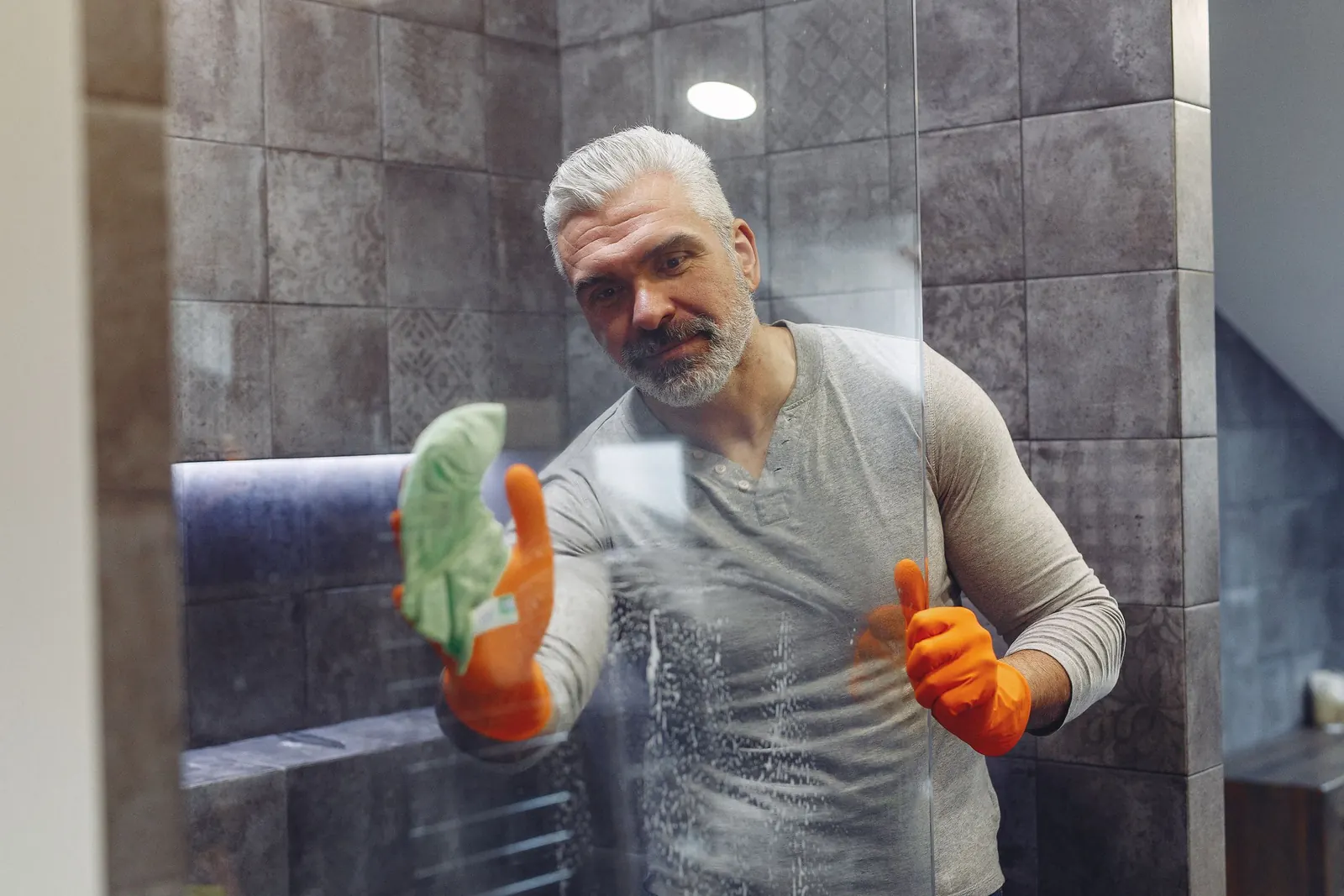
Glass shower doors and windows
- Spray the glass with undiluted vinegar or citric acid solution.
- Cover the worst areas with paper towels, spray again, and wait 15 to 30 minutes.
- Scrub with a non-scratch pad, using a toothbrush on tracks and edges.
- Rinse and squeegee dry.
If haze does not change at all after two rounds, the glass is probably etched, which is permanent. Some shower glass has a factory water-repellent coating, so check the installer’s instructions before using abrasive pads or razor blades.
Faucets, aerators, and showerheads
Faucet bodies and bases: Wrap a vinegar-soaked paper towel around the scale, cover it with plastic wrap, and wait 15 to 30 minutes. Scrub crevices with a toothbrush, rinse, and dry. Keep contact short, because chrome plating is thin.
Aerators: Unscrew the aerator (wrap pliers in a cloth), soak it in vinegar for 30 to 60 minutes, brush, rinse, and refit. A clogged aerator is a common cause of weak faucet flow.
Showerheads: Soak the head in vinegar for up to an hour. If it will not come off, tie a vinegar-filled plastic bag around it so the nozzles are submerged. Run hot water through it afterward.
Special finishes: Brushed nickel, matte black, oil-rubbed bronze, PVD, and unlacquered brass vary by manufacturer, and many care guides allow only mild soap and water. Read the care sheet before using acid.
Toilets: the hard water ring
The ring at the waterline is scale that stays wet, so it builds up thick.
- Shut off the supply valve and flush to drop the water below the ring.
- Pour 2 to 4 cups of vinegar or citric acid solution over the ring, or press acid-soaked paper towels against it.
- Wait at least an hour. Overnight is fine in a vitreous china bowl.
- Scrub with a toilet brush. For stubborn spots on vitreous china, a wet pumice stone used with light pressure works. Test a hidden spot first, and never use pumice on enamel, acrylic, or plastic.
- Turn the water back on and flush.
Scale also blocks the rim jets under the rim, which weakens flushing. Clear them with a small brush after an acid soak. Warning: many bowl cleaners contain chlorine bleach and others contain hydrochloric acid. Never use one right after the other.
Dishes, glassware, and the dishwasher
Cloudy glasses: Soak one in white vinegar for 5 to 15 minutes. If it comes out clear, the film was mineral. If nothing changes, the glass is probably etched, a permanent change often linked to soft water and too much detergent.
Preventing spots: Use rinse aid, set the dishwasher’s hardness setting (if it has one) to your measured hardness, and use a full detergent dose in hard water.
Descaling the dishwasher: Follow the manual. Some manufacturers prefer a citric acid descaler to frequent vinegar use, which can wear rubber seals. A common method is an empty hot cycle with about 2 tablespoons of citric acid powder in the detergent cup.
Kettles: Boil a half-full kettle of 1:1 vinegar and water or citric acid solution, let it stand 30 to 60 minutes, rinse several times, and boil fresh water once before use. See hard water scale and appliances for what to protect first.
What not to mix
Never mix chlorine bleach with acids, including vinegar, lemon juice, citric acid, or acidic toilet bowl and descaling cleaners. The combination releases chlorine gas. The CDC warns that household chlorine bleach can release chlorine gas if it is mixed with certain other cleaning products and says not to mix household cleaners. Symptoms include burning eyes, nose, and throat, coughing, and chest tightness.
Also avoid bleach plus ammonia, found in some glass cleaners, which releases toxic chloramine vapors. Do not combine two commercial descalers, and skip hydrochloric (muriatic) acid, which is far stronger than any household stain needs.
If someone feels unwell after mixing cleaners, get them to fresh air and call Poison Control at 1-800-222-1222.
When the stain is not hard water
Not every mineral stain is calcium. Color is the quickest clue.
| Stain color | Likely cause | What it suggests |
|---|---|---|
| White or gray crust, cloudy spots | Calcium and magnesium (hardness) | Normal hard water; acid cleaners work |
| Orange, red, or rust-brown | Iron | Iron in the water or corroding pipes; often well water |
| Black or dark brown | Manganese | Manganese in the water; common with iron |
| Blue-green | Copper | Corrosive water dissolving copper plumbing |
The EPA lists secondary standards of 0.3 mg/L for iron, which causes reddish or orange staining, 0.05 mg/L for manganese, which causes black staining, and 1.0 mg/L for copper, which causes blue-green staining. Penn State Extension notes that water containing iron or manganese may look clear from the tap but stain fixtures as it is exposed to air.
Do not use chlorine bleach on rust stains, which can set them. Rust removers, usually oxalic acid based, work better, but stains return unless the water is treated. For orange or black staining, especially on a well, read our guide to iron in well water. Raise blue-green stains with your utility or a plumber.
How to prevent hard water stains
Removal treats the symptom. These steps reduce how often you need it:
- Dry wet surfaces. A quick squeegee pass on shower glass and a towel over faucets prevent most spotting.
- Clean little and often. A weekly acid wipe takes minutes; six months of buildup takes an afternoon.
- Know your number. Check your utility’s figure on our utility reports page or the hard water map, or test at home. If you live in one of the states with the hardest water, expect faster buildup.
- Consider softening if hardness is high. An ion-exchange softener removes the calcium and magnesium that form most of these deposits. Our guide on whether you need a water softener covers thresholds and costs, and our softener vs. filter guide explains why a filter usually will not solve spotting.
Frequently asked questions
Does vinegar damage chrome faucets?
Up to about 30 minutes followed by a rinse is generally safe on intact chrome. Avoid overnight soaks and abrasive pads, and follow the manufacturer’s care sheet for special finishes such as brushed nickel or matte black.
Is citric acid or vinegar better for hard water stains?
Both dissolve calcium carbonate. Citric acid is nearly odorless and easy to mix to a known strength. Vinegar is cheap and ready to spray. Neither is safe on marble or limestone.
How do I remove hard water stains from marble or limestone?
Do not use acid. Clean with a pH-neutral stone cleaner and dry the stone after use. Dull marks left by acid are etching, which needs professional honing and polishing.
Why do hard water spots come back so quickly?
Every evaporated drop leaves its minerals behind, and in very hard water (above 180 mg/L) a single dried splash can leave a ring. Drying surfaces, rinse aid, and softening are the lasting fixes.
Are hard water stains a sign my water is unsafe?
No. White deposits are a nuisance, not a health warning; see is hard water safe to drink? Orange, black, or blue-green stains are worth investigating.