Quick answer: EPA’s secondary (aesthetic) limits are 0.3 mg/L for iron and 0.05 mg/L for manganese. Above them, water stains fixtures and laundry orange-brown (iron) or black (manganese) and tastes metallic. Iron at these levels is not a health risk. Manganese can be: EPA’s health advisory is 0.3 mg/L for lifetime drinking, and for infants under 6 months EPA advises using that 0.3 mg/L level even for short exposures. Iron is common in Midwest wells. USGS found median iron of 0.68 and 1.2 mg/L in glacial aquifers of the central and west-central United States, compared with 0.0085 mg/L for all wells sampled nationally. The right treatment depends on the concentration and form: a softener for up to about 2 to 5 mg/L of dissolved iron, an oxidizing filter for roughly 3 to 10 mg/L, and chemical oxidation or aeration with filtration above 10 mg/L.
Iron and manganese dissolve from rock and soil most readily where groundwater is low in oxygen or slightly acidic, which is why well water can look clear at the tap and turn rusty in a glass.
Signs of iron and manganese in well water
| What you see, smell, or taste | Most likely cause |
|---|---|
| Water comes out clear, turns orange or brown after standing | Dissolved ferrous iron, often called “clear-water iron” |
| Water is red, orange, or yellow at the tap | Oxidized ferric iron (“red-water iron”) |
| Orange-brown stains in sinks, toilets, and laundry | Iron above about 0.3 mg/L |
| Black or dark brown specks and stains | Manganese |
| Metallic or bitter taste; discolored coffee and tea | Iron or manganese |
| Red-brown slime in the toilet tank; swampy, oily, or sewage-like odor | Iron bacteria |
| Yellow or tea-colored water that does not settle | Organic iron or tannins from very shallow sources |
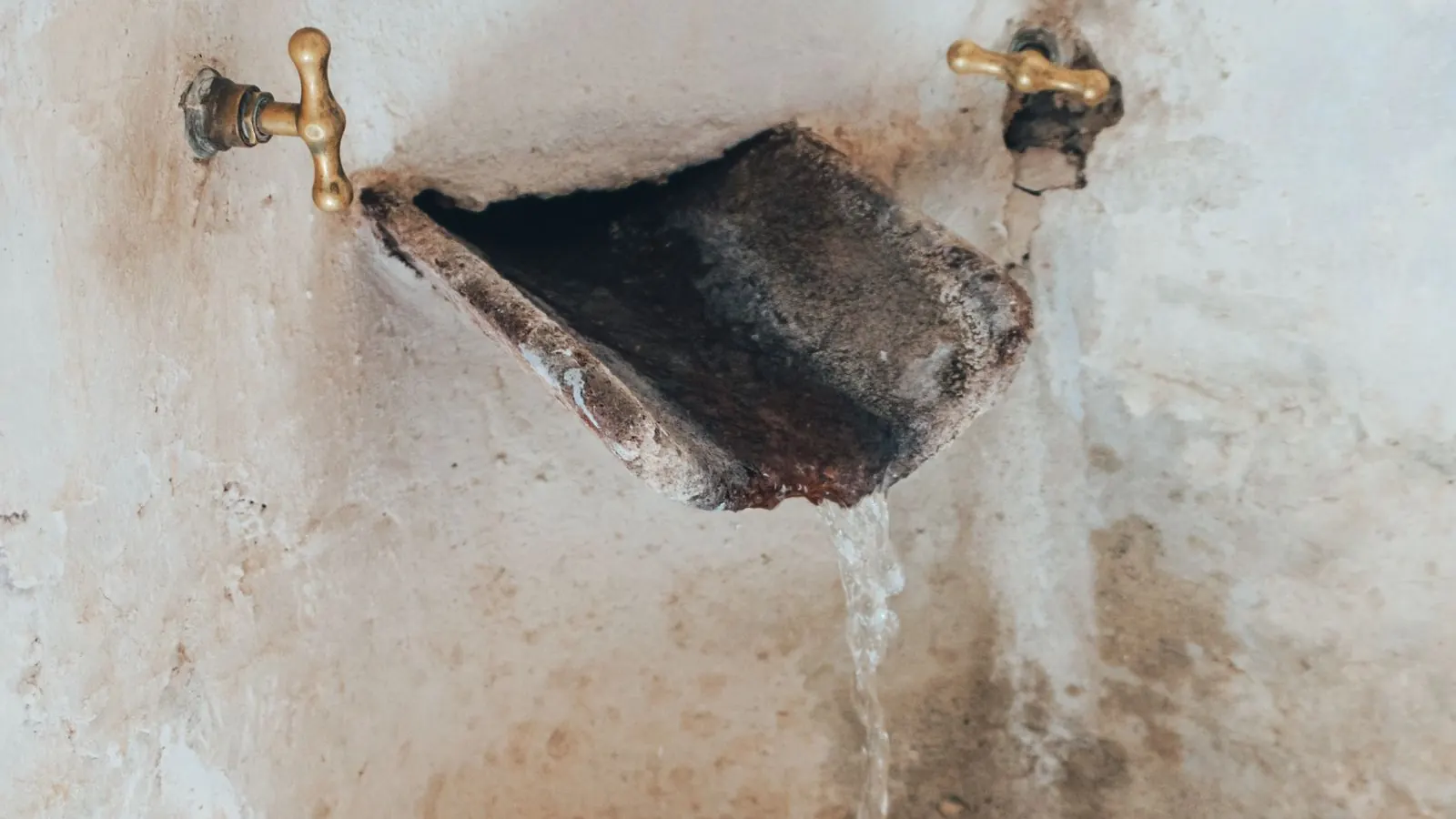
EPA lists the noticeable effects above its secondary limits: for iron, “rusty color; sediment; metallic taste; reddish or orange staining,” and for manganese, “black to brown color; black staining; bitter metallic taste” (EPA secondary standards). Iron can also clog wells, pumps, sprinklers, and dishwashers over time, according to the Minnesota Department of Health.
Iron and manganese test levels and what they mean
Private wells are not bound by federal standards, but these benchmarks are what labs and health departments compare results against.
| Result | What it means |
|---|---|
| Iron below 0.3 mg/L | Below EPA’s secondary limit; staining is unlikely |
| Iron 0.3 to 1 mg/L | Staining and taste start; usually manageable with a softener or a small iron filter |
| Iron 1 to 5 mg/L | Common in Midwest glacial wells; a softener may work for dissolved iron, otherwise an oxidizing filter |
| Iron 5 to 10 mg/L | Beyond most softeners; oxidizing filters such as manganese greensand |
| Iron above 10 mg/L | Chemical oxidation or aeration followed by filtration |
| Manganese below 0.05 mg/L | Below EPA’s secondary limit |
| Manganese 0.05 to 0.1 mg/L | Black staining likely; no health benchmark exceeded |
| Manganese above 0.1 mg/L | Above Minnesota’s guidance value for infants who drink tap water or formula made with it |
| Manganese above 0.3 mg/L | Above EPA’s lifetime health advisory and Minnesota’s guidance for everyone over one year old |
| Manganese above 1 mg/L | Above EPA’s one-day and ten-day health advisory for adults |
The manganese numbers come from EPA’s drinking water health advisory for manganese, which sets a lifetime advisory of 0.3 mg/L to protect against “potential neurological effects” and a one-day and ten-day advisory of 1 mg/L. It adds that for infants younger than 6 months, “the lifetime HA of 0.3 mg/L be used even for an acute exposure of 10 days.” The Minnesota Department of Health goes further for babies: 100 µg/L (0.1 mg/L) or less if an infant drinks tap water or formula made with it. Bathing and showering in water above those levels is not harmful, MDH notes.
Iron has no health advisory. MDH says iron in water “does not usually present a health risk,” and that most iron in the diet comes from food. Iron can make bacterial contamination harder to clear, which is one more reason to test for coliform bacteria.
How common is iron in well water? Iowa and the Midwest
Iron problems cluster by aquifer. The USGS domestic well survey found iron above 0.3 mg/L in 19 percent of wells nationally and manganese above 0.05 mg/L in 21 percent (USGS Circular 1332). Manganese exceeded the 0.3 mg/L health benchmark in about 5 percent of wells, most often in glacial aquifers. The Midwest’s glacial and carbonate aquifers stand out:
| Aquifer | Median iron | 75th / 90th percentile iron | Median manganese |
|---|---|---|---|
| West-central glacial sand and gravel | 1.2 mg/L | 2.9 / 4.5 mg/L | 0.11 mg/L |
| Central glacial sand and gravel | 0.68 mg/L | 1.6 / 2.4 mg/L | 0.027 mg/L |
| Silurian-Devonian carbonate rock | 0.65 mg/L | 1.5 / 2.3 mg/L | 0.022 mg/L |
| Cambrian-Ordovician sandstone (includes Iowa’s Jordan) | 0.11 mg/L | 0.77 / 1.5 mg/L | 0.018 mg/L |
| All US wells sampled | 0.0085 mg/L | 0.11 / 1.1 mg/L | 0.002 mg/L |
Source: USGS SIR 2008-5227, Appendix 5-2. Untreated samples from domestic wells, 1991–2004.
For the common question about the average iron test from Iowa wells, there is no published statewide average. Iowa’s wells draw from the same glacial deposits and Silurian-Devonian rock shown above, where the typical well is already above the 0.3 mg/L limit and one in four is above about 1.5 mg/L. Wells in the deeper Jordan aquifer tend to have less iron. Neighboring wells can still differ: MDH warns that “the iron content of two nearby wells may be quite different.”
Iowa well owners can ask their county about free testing through the Iowa Private Well Grants Program (State Hygienic Laboratory). The tests the program’s state data cover are bacteria, nitrate, and arsenic, so ask whether iron and manganese can be added. Our Iowa page lists local options, and well water hardness covers the rest of a typical Iowa well report.
What to test before choosing treatment
A single iron number is not enough to choose equipment. MDH suggests testing hardness, pH, alkalinity, and iron bacteria along with iron, because each one changes which treatment works. Order these on untreated water:
- Iron (total, and dissolved if the lab offers it)
- Manganese
- Hardness, because a softener needs it and iron adds to the load
- pH, because several filters only work above set values
- Alkalinity and total dissolved solids
- Iron bacteria if you see slime or smell swampy odors
- Coliform bacteria and nitrate, the annual safety tests
In 2026 the Wisconsin State Laboratory of Hygiene charges $38 each for iron and manganese and $72 for iron bacteria; Penn State’s $85 aesthetics package bundles hardness, iron, manganese, pH, alkalinity, and bacteria. Our guide on where to get water tested explains how to find a certified lab.
Treatment options by concentration
These ranges come from Penn State Extension and the Minnesota Department of Health. They are guides, not guarantees; water chemistry and the form of iron matter.
| Treatment | Works best for | Key conditions and drawbacks |
|---|---|---|
| Polyphosphate feed | Dissolved iron below 2 mg/L | Hides iron rather than removing it; generally ineffective for manganese; can release iron in water heaters |
| Catalytic carbon filter | Dissolved iron below 1 mg/L | Needs at least 4 mg/L dissolved oxygen in the water |
| Water softener | Dissolved iron below about 2 to 5 mg/L | pH above 6.7 and hardness of 3 to 20 gpg; no air or chlorine contact before the softener |
| Birm filter | Moderate iron | pH of at least 6.8 for iron and 7.5 for manganese; variable manganese removal; needs backwashing |
| Manganese greensand filter | Combined iron and manganese of about 3 to 10 mg/L (MDH: up to 10 to 15 mg/L iron) | Regenerated with potassium permanganate; regular backwashing |
| Chlorine, permanganate, or peroxide plus filtration | Combined iron and manganese above 10 mg/L; organic iron | Needs contact time and careful dosing; carbon filter may be needed for taste |
| Aeration plus filtration | Iron above 10 mg/L | No chemicals, higher purchase cost; needs a filter and disinfection |
| Reverse osmosis or distillation | Drinking water at one tap | Removes any form of iron but clogs quickly at high levels |
Connecting to a public water system or drilling into a different formation are alternatives, though MDH cautions that a new well’s iron level is hard to predict.
Water softeners and iron: what works and what fails
Ion-exchange resin removes dissolved iron and manganese along with calcium and magnesium. That makes a softener the simplest fix for many hard, moderately iron-rich wells, as long as the conditions are right.
- Keep iron dissolved until it reaches the resin. Penn State says raw water should not contact air or chlorine before the softener. MDH notes that an air-charged galvanized pressure tank can make a softener less effective, because oxidized iron particles foul the resin.
- Stay within the iron limit. Penn State recommends a softener only when dissolved iron is below 5 mg/L, pH is above 6.7, and hardness is 3 to 20 gpg. MDH says some manufacturers claim up to 10 mg/L, “however, 2 to 5 mg/L is a more common limit.”
- Do not rely on a softener for low-hardness, high-iron water. MDH says it will be less effective there.
- Count iron and manganese when sizing. Our softener size calculator adds 4 gpg of hardness for each mg/L of iron or manganese, the midpoint of 3 to 5 gpg rules of thumb used in the trade.
- Expect more maintenance. Iron must be periodically removed from the resin by backwashing, MDH notes, and the manufacturer’s maintenance schedule applies.
- Put the iron filter first. When iron exceeds the softener’s limit, the iron filter goes ahead of the softener so iron does not foul the resin.
Softeners can also lower manganese: an MDH study in Dakota County found them “an effective way to reduce the level of manganese in drinking water.” If infants drink the water, test after treatment. See also water softener vs. water filter, do I need a water softener?, and, for existing stains, how to remove hard water stains.
Iron bacteria: signs and control
Iron bacteria combine iron or manganese with oxygen to form rust deposits and a slimy film on pipes, pumps, and fixtures. MDH says they are “not known to cause disease,” but they can create conditions where other organisms grow, reduce well yield, and make an iron problem much worse.
- Confirm it. A lab test for iron bacteria costs about $72 at the Wisconsin state lab.
- Clean first. In heavily affected wells, a licensed well contractor physically removes deposits.
- Shock chlorinate. MDH recommends a chlorine concentration close to, but not above, 200 ppm, after pumping the well until clear. Stronger solutions are less effective.
- Expect repeats. Chlorine may not eliminate iron bacteria in one treatment. MDH does not usually recommend continuous chlorine injection, which can hide other contamination and cause corrosion.
- Prevent reintroduction. Use only disinfected water during repairs, keep the casing capped and at least 1 foot above ground, and keep pump parts off the ground.
FAQ
Is iron in well water harmful to drink?
Not at typical well levels. EPA’s 0.3 mg/L iron limit covers taste and staining, and MDH says iron in water does not usually present a health risk. The real problems are stains, clogs, and iron bacteria.
Is manganese in well water dangerous?
It can be at higher levels, especially for infants. EPA’s lifetime health advisory is 0.3 mg/L, and it advises using that level even for short-term exposure of infants under 6 months. Minnesota recommends 0.1 mg/L or less when an infant drinks tap water or formula made with it.
What is a normal iron level in well water?
Nationally, the median well in the USGS survey had very little iron, about 0.0085 mg/L, but 19 percent were above 0.3 mg/L. In Midwest glacial and carbonate aquifers, 0.6 to 1.2 mg/L is typical, and 2 to 4 mg/L is not unusual.
Will a water softener remove iron?
Yes, for dissolved (clear-water) iron within limits: commonly up to 2 to 5 mg/L, with pH above 6.7 and enough hardness. A softener does not handle iron that has already oxidized into particles well, and iron or chlorine reaching the resin fouls it. Above those limits, use an iron filter ahead of the softener.
Why does my well water turn orange after sitting?
Dissolved ferrous iron (clear-water iron) is reacting with oxygen and forming rust particles. It points to iron above about 0.3 mg/L; a lab result tells you which treatment fits.
Sources
- EPA: Secondary Drinking Water Standards: Guidance for Nuisance Chemicals
- EPA: Drinking Water Health Advisory for Manganese (PDF)
- Minnesota Department of Health: Iron in Well Water
- Minnesota Department of Health: Manganese in Drinking Water
- Minnesota Department of Health: Iron Bacteria in Well Water
- Penn State Extension: Iron and Manganese in Private Water Systems
- USGS Circular 1332: Quality of Water from Domestic Wells (overview)
- USGS Scientific Investigations Report 2008-5227 (appendix tables)
- State Hygienic Laboratory at the University of Iowa: Private Well Water
- Wisconsin State Laboratory of Hygiene: Water Testing Prices